The Invisible Border: Black Money vs. Dirty Money
In the domain of Anti-Money Laundering and Counter-Terrorism Financing (AML/CFT), there is a fine line that, while legally distinct, often blurs within the operational flow of the global financial system. We are talking about the difference between black money and dirty money.
For a compliance officer, regulator, or financial intelligence specialist, understanding this distinction is not merely an academic exercise; it is the cornerstone of dismantling the financial networks that support everything from tax evasion to transnational organized crime.
In this article, we analyze these concepts from a technical yet accessible perspective, using everyday examples to reveal how seemingly harmless actions can act as catalysts for global financial opacity.
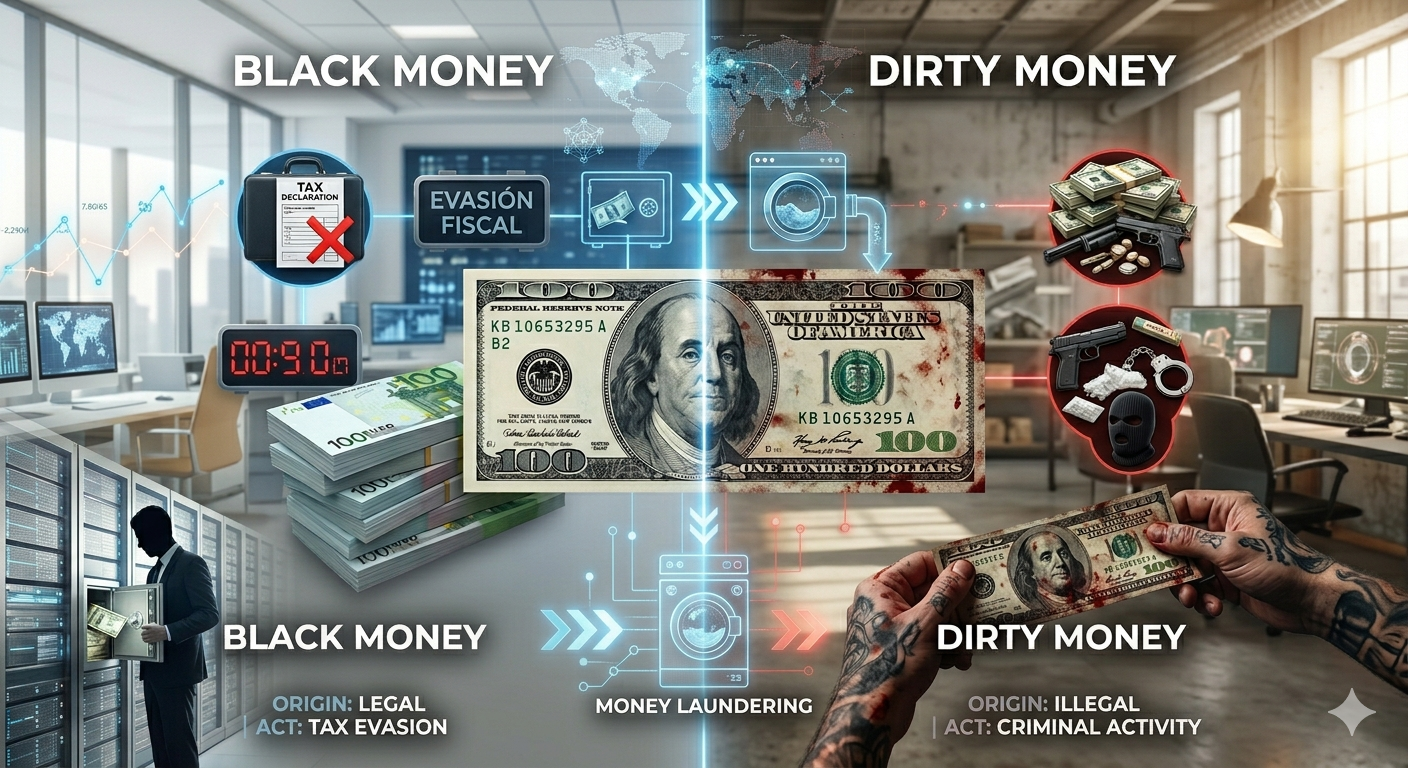
Image produced under the creative direction of the author using generative AI tools. ©2026 All rights reserved.
Black Money: Tax Evasion and Legal Origins
Technically, black money refers to capital derived from fully licit and legal economic activities but deliberately concealed from tax authorities to evade tax liabilities.
Here, the infraction does not lie in how the money was generated, but rather in its failure to be declared, registered, and taxed. It constitutes a tax offense that directly erodes the state's economy.
10 Practical Examples of Black Money:
Evasion of corporate VAT: Merchants deliberately omitting invoice issuance to avoid reporting and paying Value Added Tax.
Unreported professional fees: Independent contractors (physicians, lawyers, consultants) demanding cash-only payments to keep revenues off the tax radar.
Informal real estate rentals: Property lease payments transacted entirely outside legally registered rental contracts.
"Under-the-table" wages: Paying employee salaries in cash, either fully or partially, to avoid social security contributions and payroll taxes.
Unreported cryptocurrency gains: Failing to report capital gains derived from cryptocurrency trading or decentralized finance.
Unreported offshore accounts: Maintaining legally sourced funds in low-tax foreign jurisdictions without disclosing them to local tax authorities.
Fictitious business expenses: Declaring personal expenditures as corporate expenses to fraudulently reduce taxable corporate net income.
Under-invoicing of registrable assets: Reporting the sale of a vehicle or real estate at its minimum tax value while transacting the remaining balance in cash.
Omission of variable income: Excluding cash tips, extraordinary performance bonuses, or commissions from annual tax declarations.
Concealment of inheritances: Hiding inherited assets or estates to evade inheritance and gift taxes.
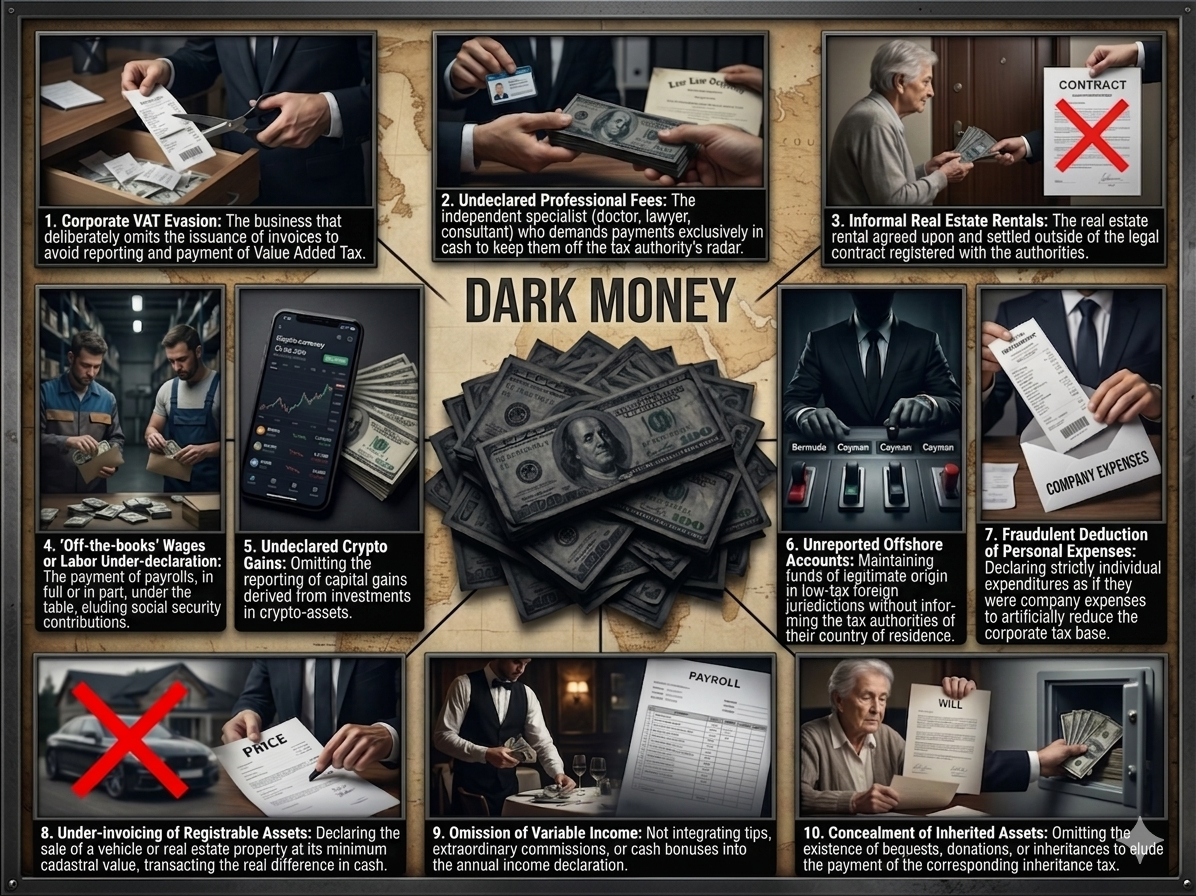
Image produced under the creative direction of the author using generative AI tools. ©2026 All rights reserved.
Dirty Money: The Fuel of Organized Crime
In contrast, dirty money originates directly from criminal activities. Under international compliance frameworks (such as the FATF recommendations), these are classified as predicate offenses for money laundering. In this case, both the source of the capital and its subsequent circulation violate criminal law.
10 Practical Examples of Dirty Money:
Drug trafficking: Financial proceeds derived from the illicit production, distribution, and sale of controlled substances.
Extortion and cyber-extortion: Capital generated through physical coercion, blackmail, or digital ransom attacks (ransomware).
Illicit arms trafficking: Funds resulting from the illegal trade and smuggling of weaponry and military gear.
Human trafficking: Revenue generated from sexual exploitation, forced labor, or migrant smuggling.
Public and corporate corruption: Bribes, embezzlement, kickbacks, and misappropriation of public funds by state officials or corporate executives.
Illegal gambling: Profits from clandestine casinos, unauthorized sports betting, or unregistered lotteries.
Cybercrime and digital fraud: Funds obtained through phishing schemes, digital banking fraud, and identity theft.
Contraband and smuggling: Revenue generated from the illegal import/export of goods to evade customs duties and regulatory bans.
Kidnapping and ransom: Money extorted for the release of hostages (a primary source of terrorist financing).
Environmental crimes: Financial gains from the illegal wildlife trade, illegal logging, and unauthorized mining operations.

Image produced under the creative direction of the author using generative AI tools. ©2026 All rights reserved.
"Micro-Complicity": 10 Everyday Actions that Weaken the System
As world citizens, we often normalize certain behaviors under the guise of "financial street-smartness" or economic self-preservation. However, from a compliance perspective, these actions weaken the global financial infrastructure and pave the way for organized crime to infiltrate legitimate economies.
"Lending your bank account" (Money Muling): Accepting transfers from third parties to withdraw cash as a favor can constitute a "smurfing" scheme and passive money laundering.
"No invoice, lower price" (Tax erosion): Asking for discounts in exchange for not receiving an invoice directly de-funds critical public sectors like health, education, and infrastructure.
"Family strawmen" (Concealing the beneficial owner): Placing assets, vehicles, or bank accounts under the name of spouses or children to shield wealth from tax authorities or legal claims.
"Systematic and excessive cash use": Avoiding digital payment channels drastically reduces financial traceability, hindering investigations by Financial Intelligence Units (FIUs).
"Falsifying transaction profiles": Lying or omitting information when declaring the source of funds during bank Know Your Customer (KYC) processes.
"Structuring deposits" (Smurfing): Breaking down large cash deposits into multiple smaller transactions to avoid triggering mandatory threshold reporting by financial institutions.
"Purchasing luxury goods in cash": Buying high-value assets (art, jewelry, luxury vehicles) in cash, feeding sectors that lack rigorous AML controls.
"Ignoring the Beneficial Owner (Shell Companies)": Setting up opaque corporate structures solely to shield assets and hide the true controlling individual.
"Informal hiring": Paying for household or professional services off the books, leaving workers without social security and fostering the shadow economy.
"Accepting client gifts": In regulated or public sectors, accepting personal gifts violates compliance codes and represents the starting point of passive bribery.
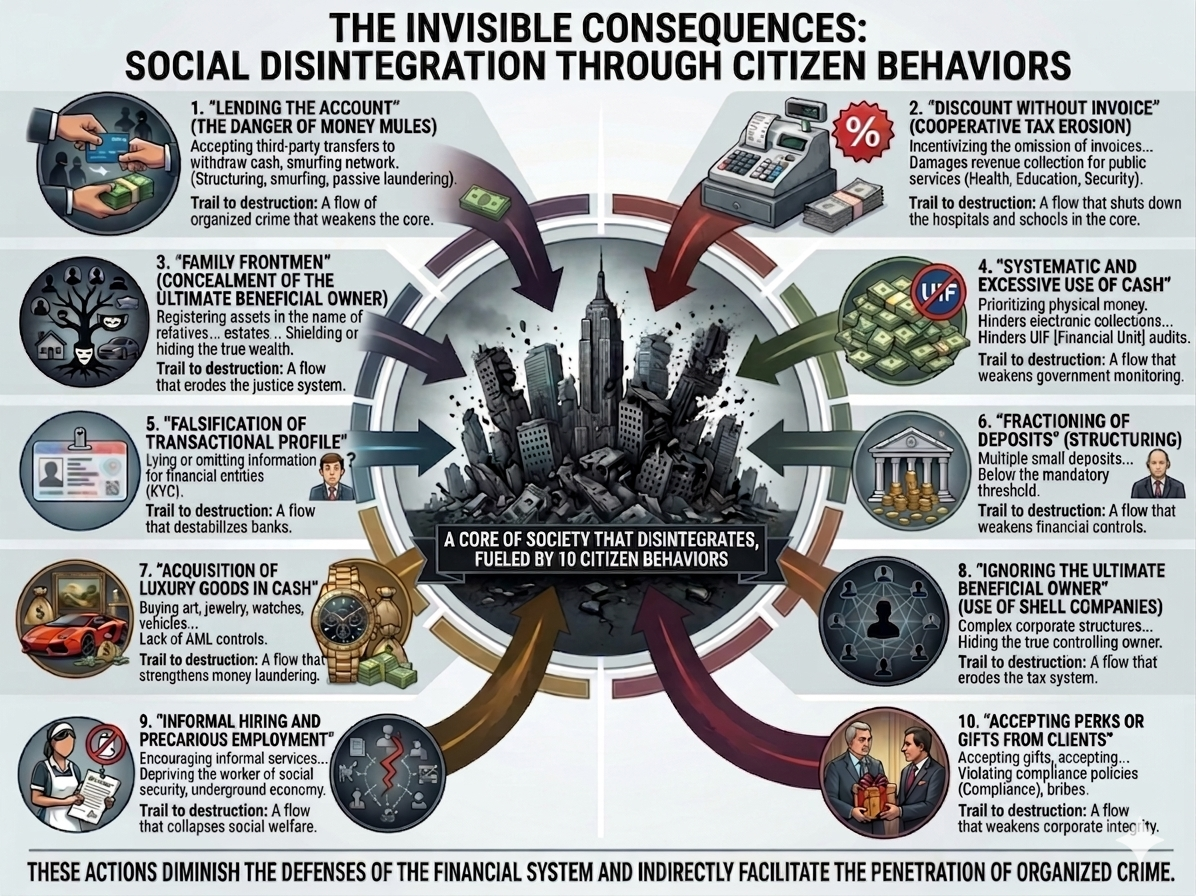
Image produced under the creative direction of the author using generative AI tools. ©2026 All rights reserved.
Opacity is the Oxygen of Crime
It is highly tempting to classify black money as a minor infraction or a victimless civic trick to survive economic hardship. However, for AML/CFT specialists, this boundary is extremely porous.
Unreported capital does not just de-fund the state; it establishes parallel, opaque financial pipelines that dirty money subsequently uses to blend in and flow undetected. When a society tolerates and normalizes the unmonitored flow of black money, it is building the very highway that organized crime uses to thrive. It constructs the infrastructure that drug cartels, corrupt officials, and terrorist organizations need to prosper.
Transparency is not a regulatory burden or a bureaucratic whim; it is an essential social antivirus designed to protect our economic and democratic integrity. Financial opacity is the oxygen of organized crime. A society that strives for justice cannot be complicit in its own shadow. Transparency is the basic contract guaranteeing that the money flowing through our streets is free from the stains of violence, exploitation, and theft.
Money laundering does not clean capital; it dirties a country's future.
